Togra for Australian producers
A walkthrough of how Togra runs an Australian production company: the company calendar, the Producer Offset from the significant Australian content test to the claim, Screen Australia and state agency applications, Screen Australia's recoupment terms, the BAS and residuals.
What an Australian company gets
A company that chooses Australia as its home works in Australian dollars and Australian terms: its ACN, its ABN and GST registration, an Australian bank, and child performers under the Australian regime. Irish and UK statutory pages stay out of its menus unless a project touches those countries.
- A Cúram starter pack with the ASIC, ATO and state dates an Australian Pty Ltd keeps.
- The Producer Offset worksheet for the significant Australian content test, with the 40% and 30% rates, the minimum QAPE for each format, and the certificates and claim tracked through to the refund; the Location Offset and PDV Offset for productions that take those instead.
- Application bundles for Screen Australia's programs and for each state and territory agency's production fund, and the funder rounds under the agencies' current program names.
- A waterfall that starts from Screen Australia's Terms of Trade.
- The GST labels of the BAS drafted from the company's transactions.
- Residuals under the MEAA, ADG, AWG and APRA AMCOS agreements.
- Co-production with Ireland (agreement signed 4 February 1998), the UK and Canada under Australia's treaties.
The producer's journey
-
An Australian company
The company profile asks for the ACN, the registered office, an Australian bank and the ABN with its GST registration. Australia as the home territory sets the credit, the funders and the terms used across the slate.
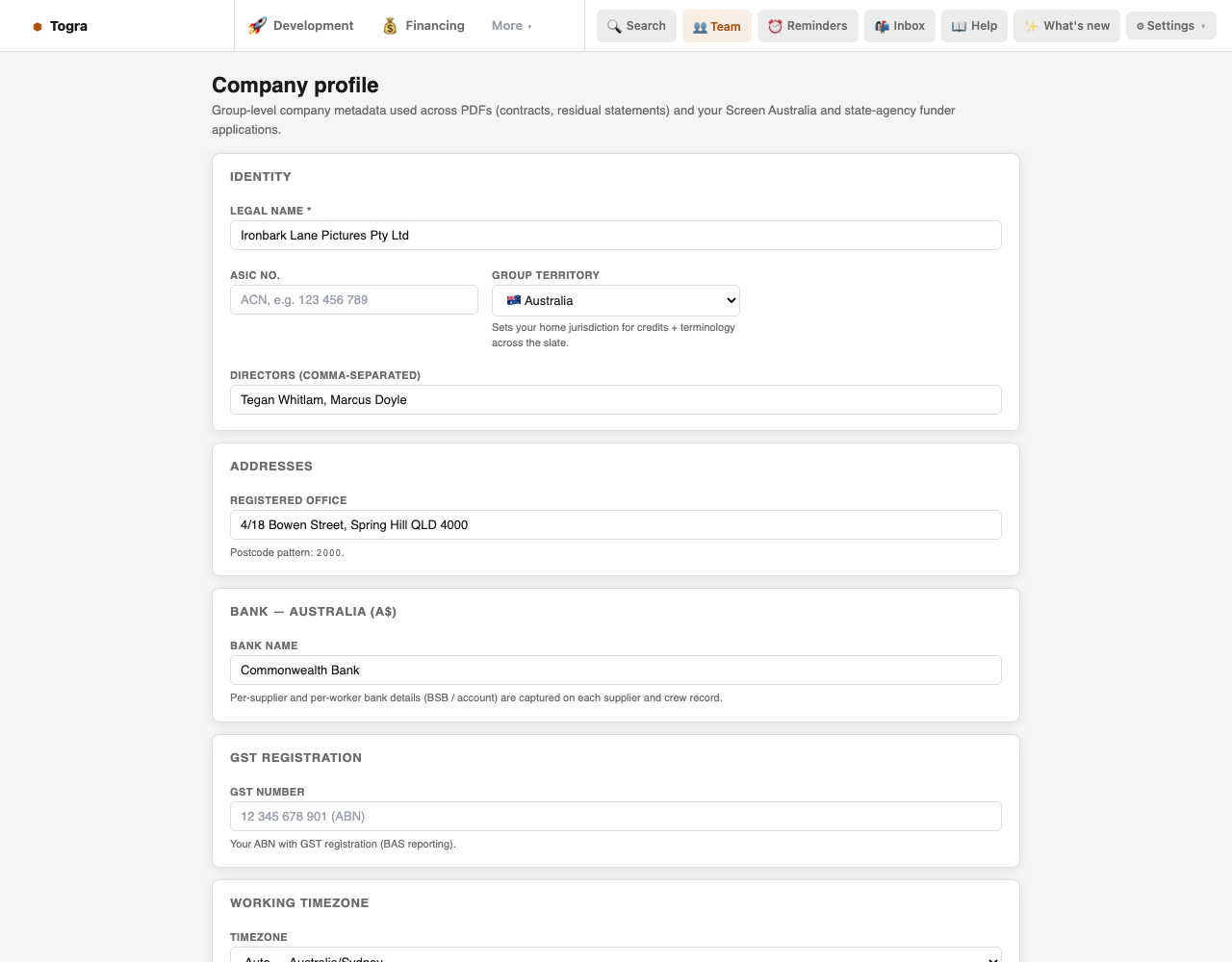
Company profile. -
The company calendar
Cúram's Australian starter pack lays out the year an Australian Pty Ltd keeps: the ASIC annual review fee and statement with the directors' solvency resolution, the quarterly BAS on 28 October, 28 February, 28 April and 28 July, PAYG withholding, super paid with each pay under Payday Super, STP finalisation by 14 July, the FBT return on 21 May, the company tax return and the 1 December tax payment, and a check of the state's payroll tax and workers' compensation rules.
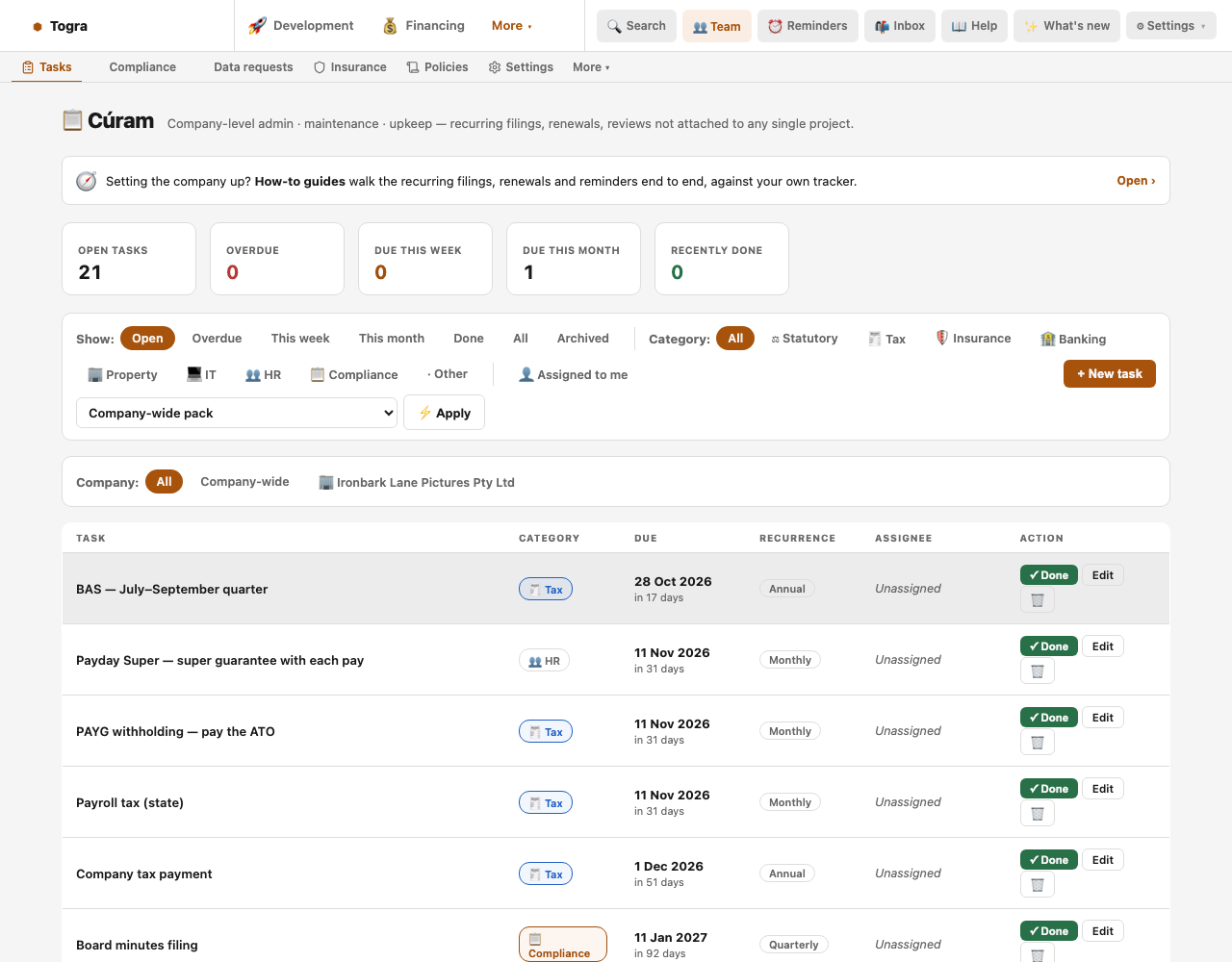
Cúram after applying the Australian starter pack. -
The Producer Offset
The Producer Offset worksheet takes the format, who the film is made for and the applicant company, and sets the rate: 40% of QAPE for a feature made for commercial exhibition in cinemas, 30% for other eligible projects. It checks the minimum QAPE for the format, A$500,000 for a feature, and walks the significant Australian content test question by question with the evidence for each. Screen Australia judges the test as a whole, so the worksheet records the answers and gives no score. Where a film does not qualify, the Location Offset or the PDV Offset, 30% each, may apply instead.
- A$5,200,000
- Estimated QAPE for the demo feature, above the A$500,000 minimum.
- A$2,080,000
- The Producer Offset at 40%, carried to the finance plan as a pending line.
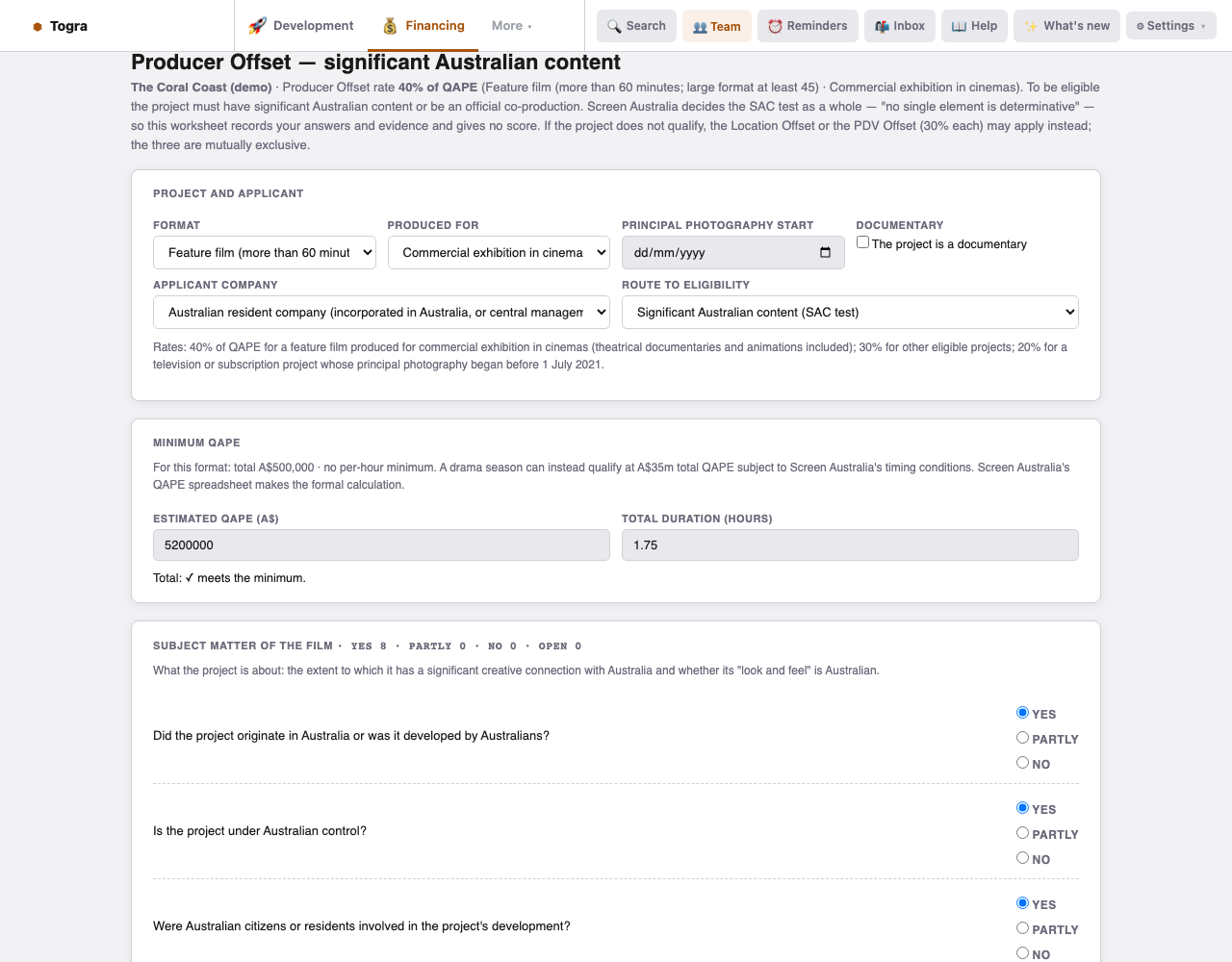
Producer Offset worksheet. Below the test, the worksheet tracks the Offset to the refund. The provisional certificate is optional; the fee follows the budget, A$1,682 for the demo's A$6.5M, and the expected decision window follows the date applied. Once the project is complete, the final certificate needs an audit by a registered company auditor and six documents, checked off one by one. The Offset is claimed in the company tax return for the year the project is completed, at label E (Refundable tax offsets). A project Screen Australia funds is reminded to contribute at least 90% of the projected Offset to the budget, 85% for a documentary.
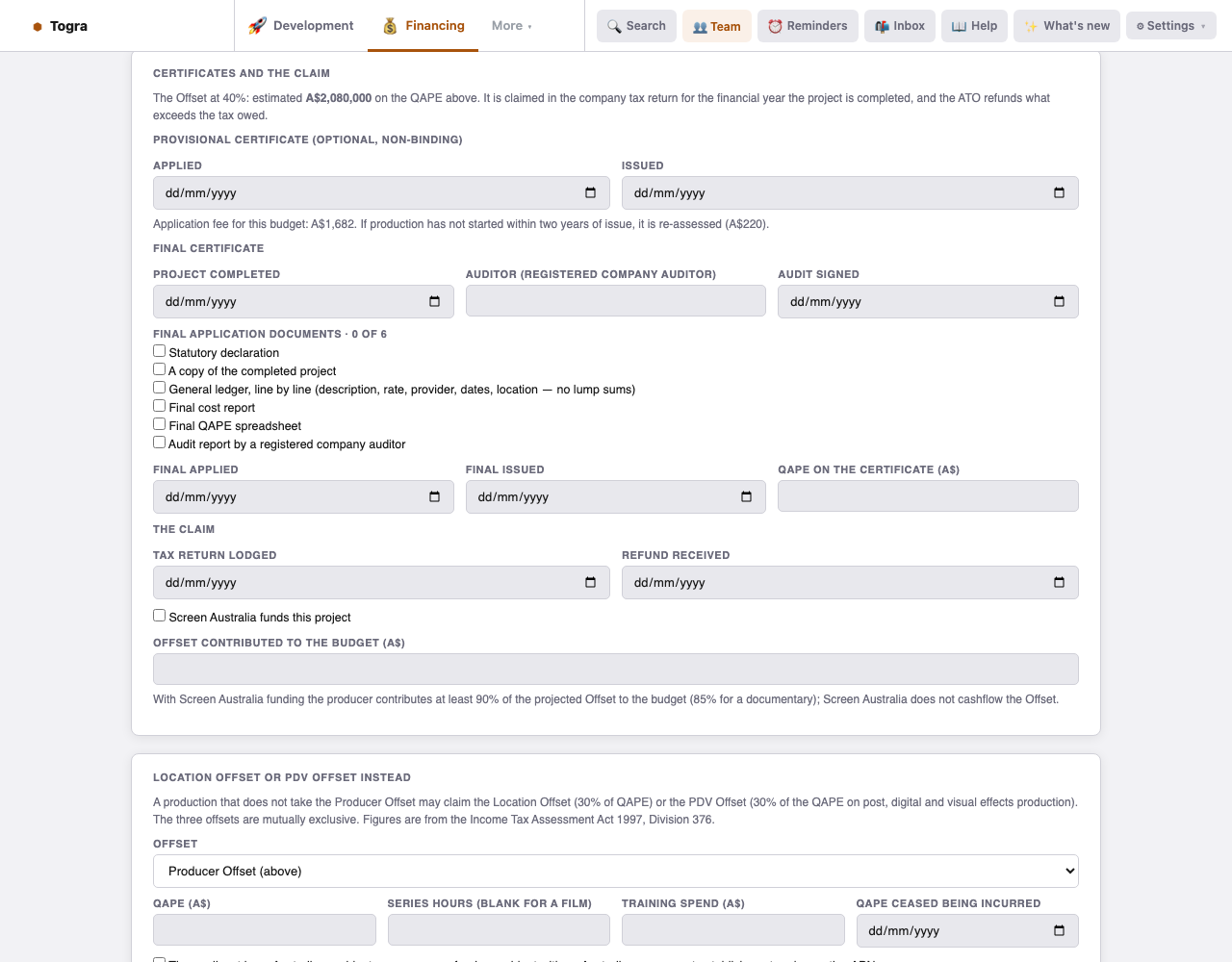
Certificates and the claim. A production that takes the Location Offset or the PDV Offset works it on the same page, from the Income Tax Assessment Act 1997, Division 376: 30% of QAPE, at least A$20 million of QAPE (A$1.5 million an hour for a series) for the Location Offset and A$500,000 for the PDV Offset, the PDV contract with an Australian provider, and training spend of the lesser of A$500,000 and 1% of QAPE for productions from 1 July 2025. Either offset needs an Australian resident applicant, or a foreign resident with an Australian permanent establishment and an active ABN. For the PDV Offset the worksheet also follows the July 2026 guidelines: documentary features are out (documentary series are in), the offsets are exclusive only once a final certificate issues, and it sets out the process, about 10 weeks for a provisional certificate and 20 for the final, through the Film Certification Advisory Board.
- A$9,600,000
- Location Offset at 30% on an example A$32M of QAPE.
- A$320,000
- The training spend it requires, 1% of QAPE; A$200,000 entered, so the check stays open.
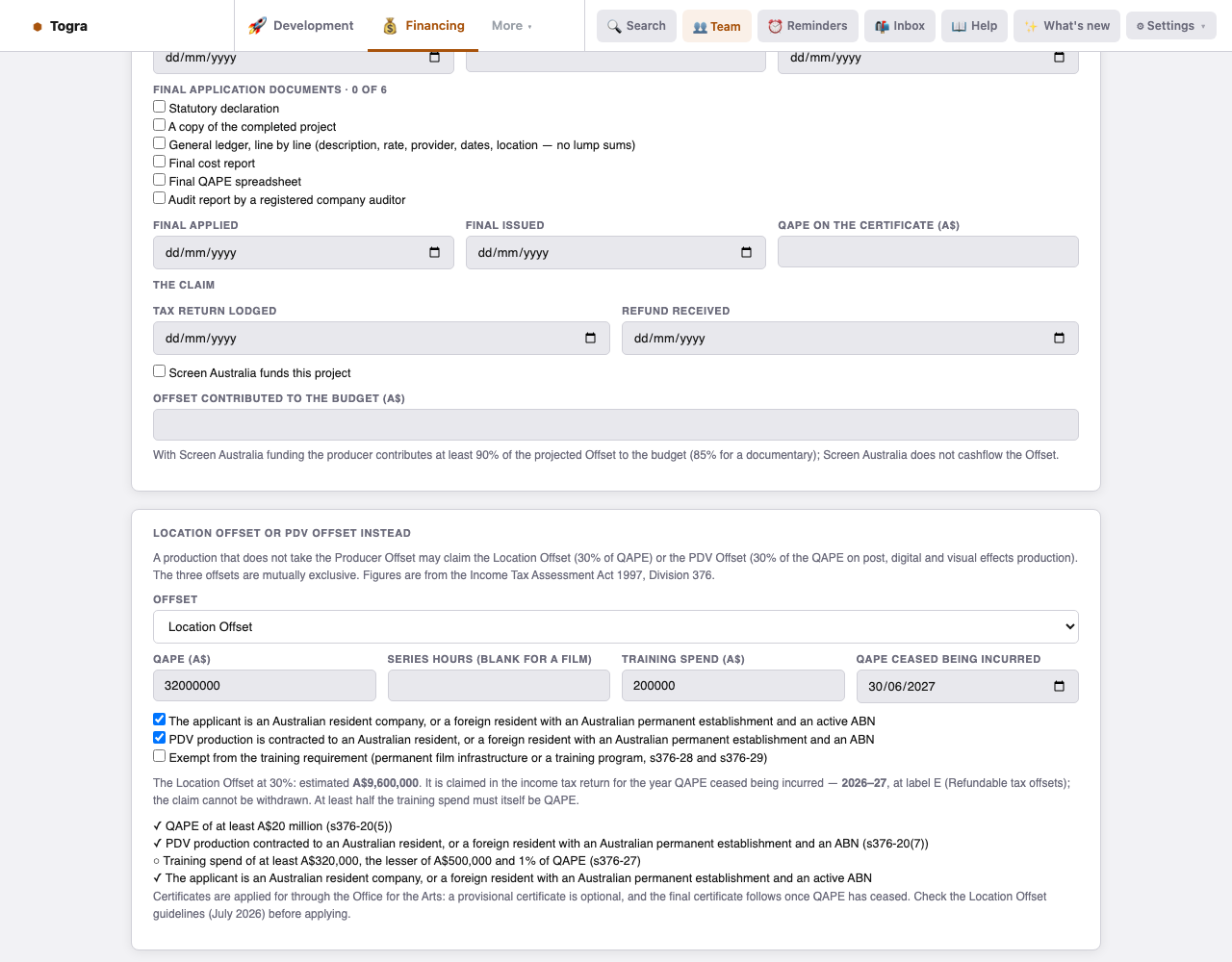
Location Offset, with example figures. -
Screen Australia and state applications
Funder applications open on an Australia tab: Screen Australia's Narrative Content Production, Documentary Production, direct-to-audience drama, International Finance Attraction and First Nations production, and a bundle for each state and territory agency's production fund: Screen NSW, VicScreen, Screen Queensland, SAFC, Screenwest, Screen Tasmania, Screen Territory and Screen Canberra. Each state bundle fills the project and company and sets out, from the agency's current guidelines, its share of local spend and cap, whether it is a grant or equity, the eligibility rules, the documents it asks for and its assessment criteria. The amount sought is left for the producer.
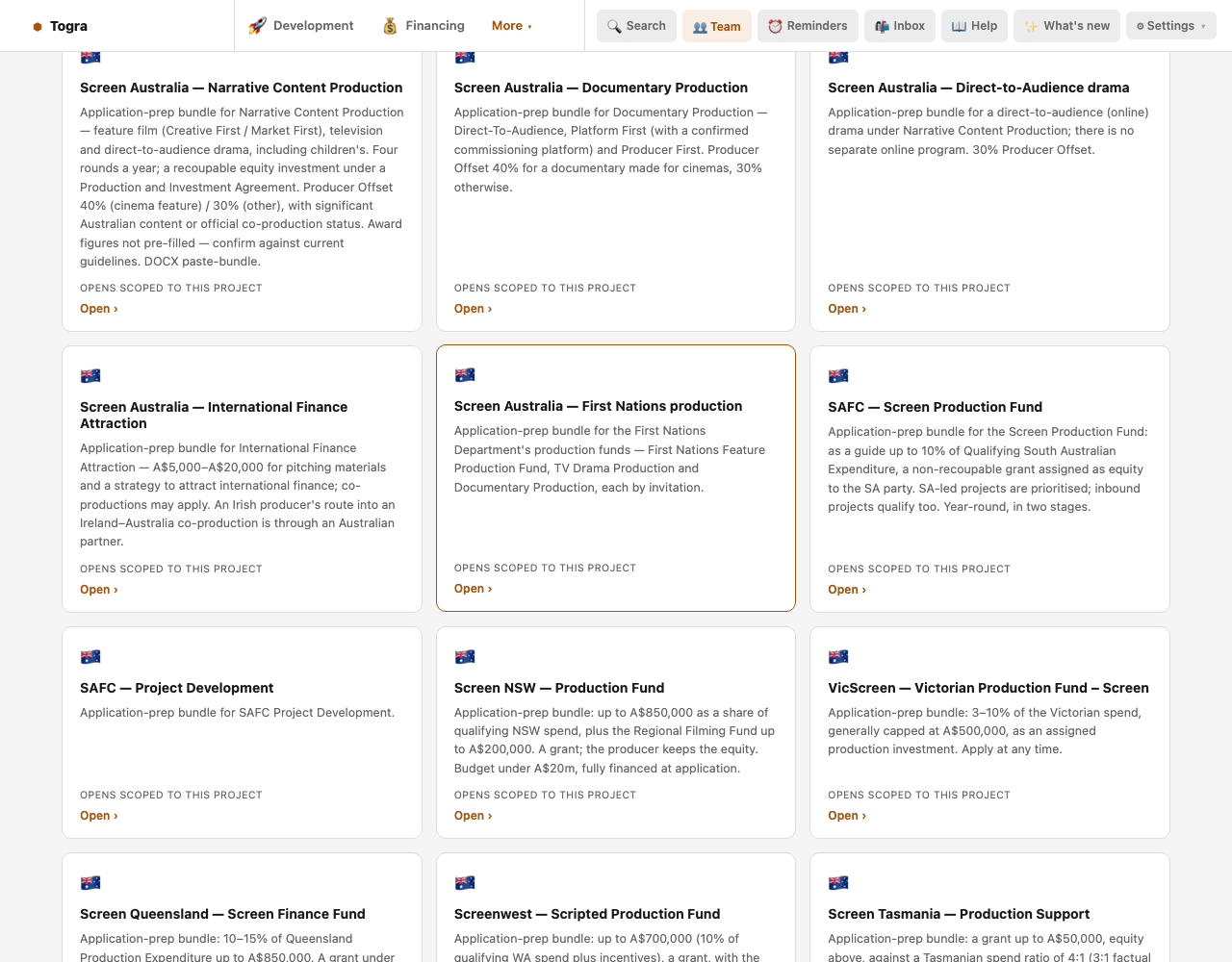
Funder applications, Australia tab. -
The funder calendar
One click loads Screen Australia and the eight state and territory agencies under their current program names, with the published round dates. Among the rounds matching the demo feature, Screen Queensland's Screen Finance Fund closes on 28 October for the December board, Screen NSW's Production Fund runs 19 October to 23 November, and Screen Canberra's round 2 closes on 19 March 2027.
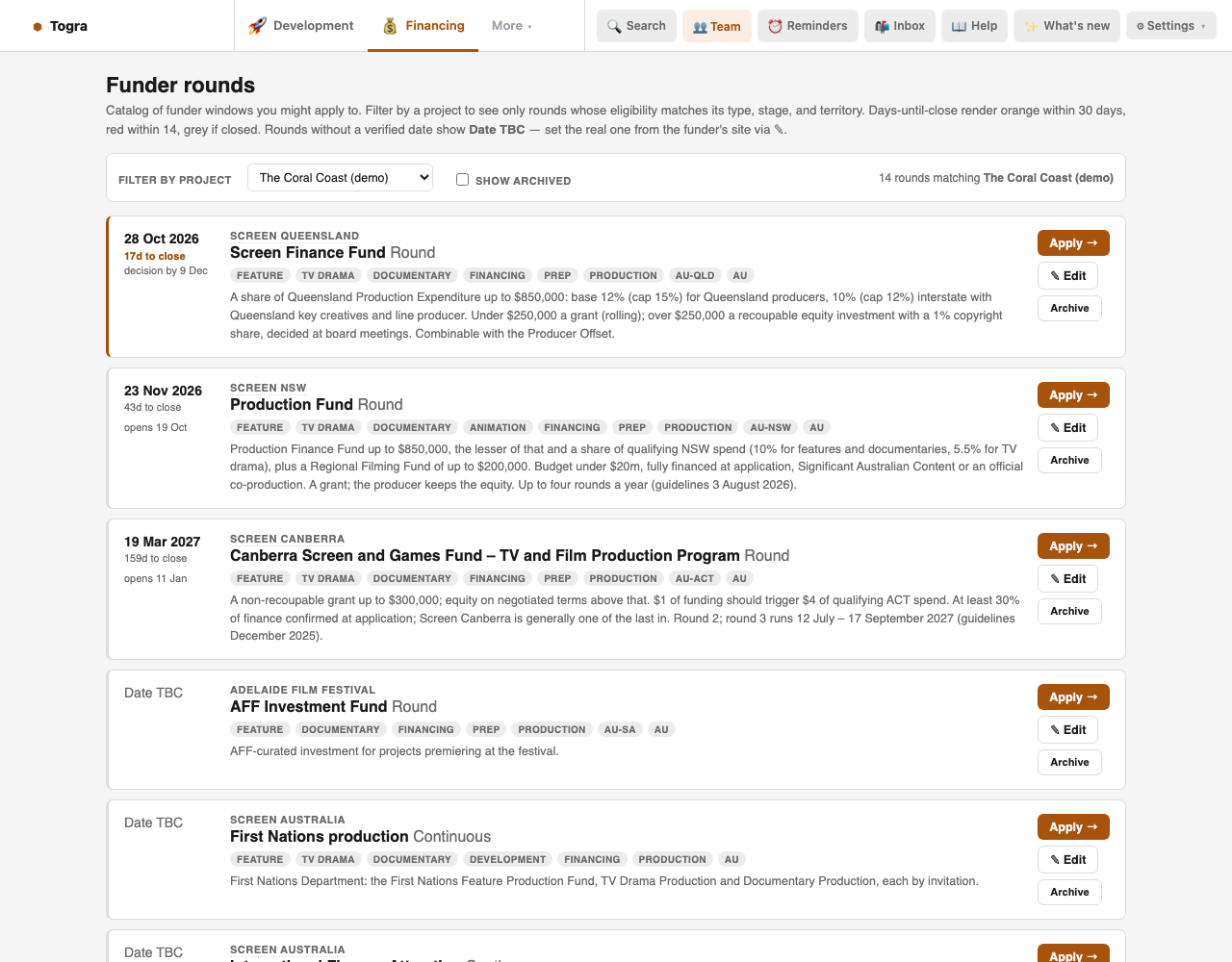
Funder rounds matching the demo project. -
Screen Australia's recoupment terms
An empty waterfall can start from Screen Australia's Terms of Trade, filled from the active finance plan: a collection account manager unrelated to the producer, sales fees and capped expenses, the distribution advance, then Screen Australia's equity, the producer's equity and the other investors recouping pro rata and pari passu. Funding of A$500,000 or less is treated as a grant and counted as producer equity alongside the Producer Offset contributed. Once equity is repaid, profit splits 50:50 between the producer and the equity investors.
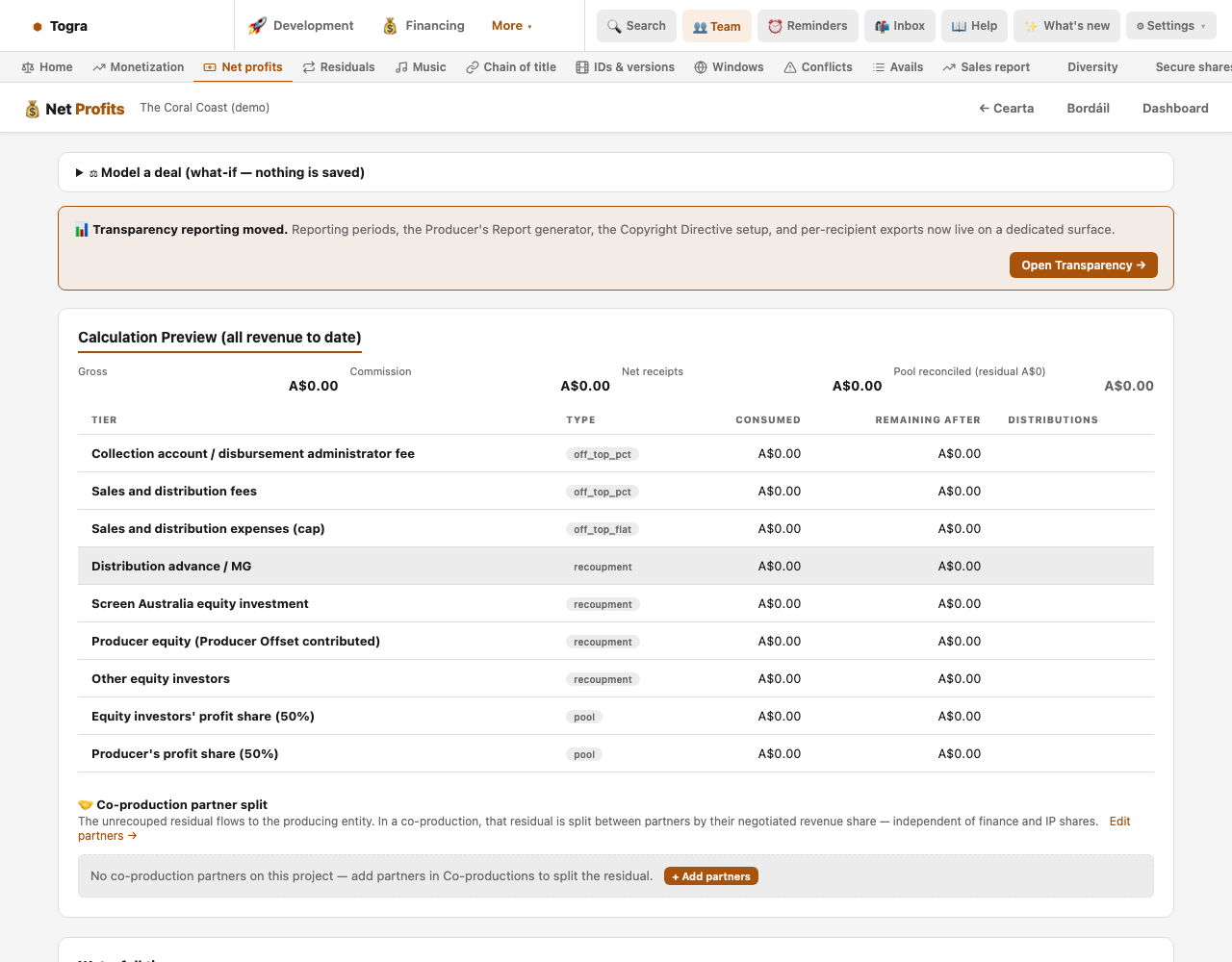
Waterfall from Screen Australia's Terms of Trade. -
The BAS
The return helper drafts the GST labels of the BAS from the company's transactions, once each account has a GST treatment. The G labels carry the GST-inclusive amounts, with exports at G2 inside G1 and capital purchases at G10; 1A and 1B carry the GST. Wages sit outside the GST. PAYG withholding comes from payroll and is entered at lodgment.
- A$128,000
- G1, total sales including the A$40,000 export at G2.
- A$3,300
- GST payable: A$8,000 at 1A less A$4,700 at 1B.
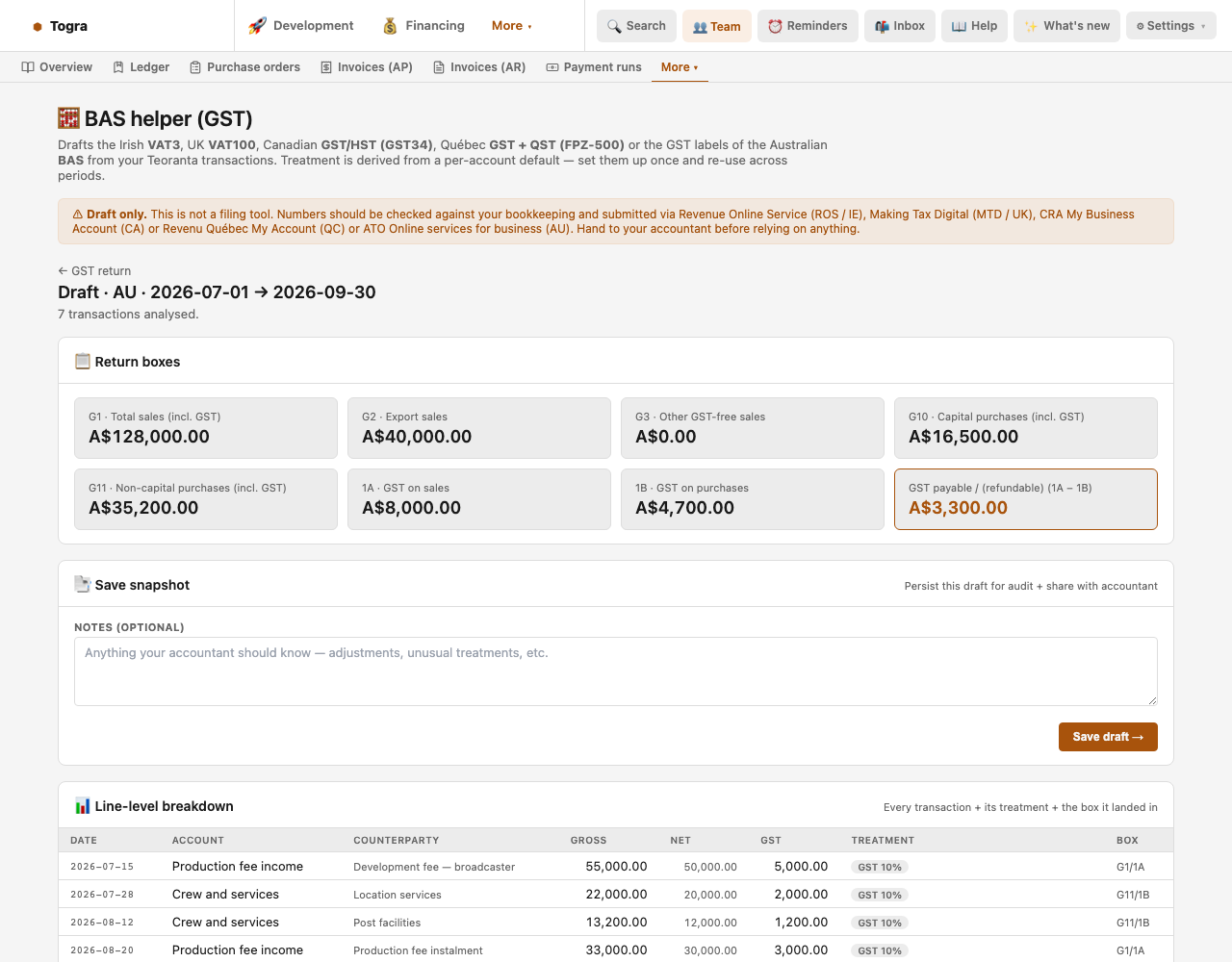
BAS draft from sample transactions. -
Residuals
Each beneficiary carries an obligation under its guild agreement: MEAA Equity for cast, the ADG for the director, the AWG for the writer, and APRA AMCOS for the score, with a rate-card lookup to prefill from the agreements. Payments are logged against each obligation.
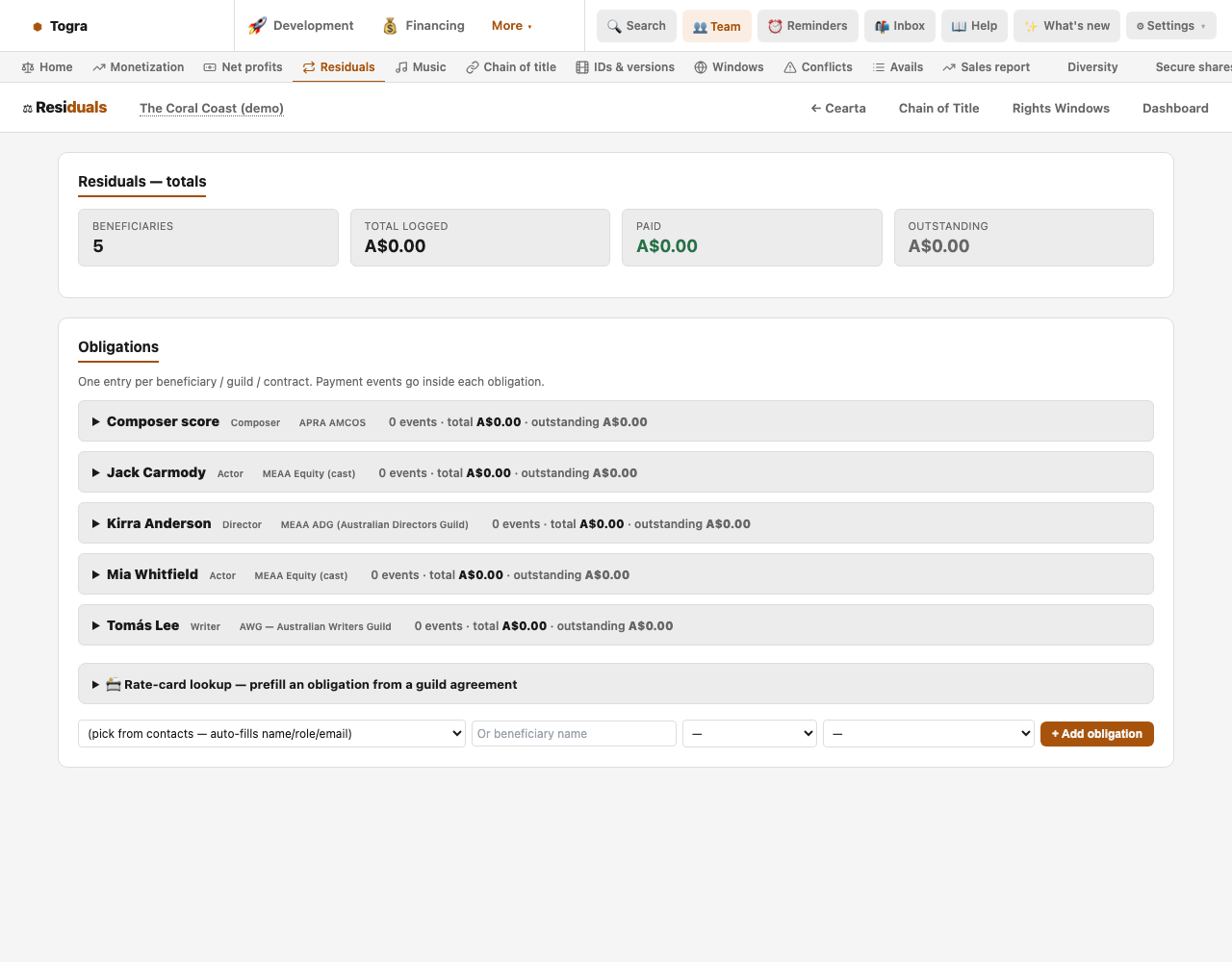
Residual obligations.
Also in the module, not shown here
- Co-production under the Ireland–Australia, UK–Australia and Canada–Australia treaties and their trilateral combinations, in the co-production structurer.
- Child performers under the Australian regime, with working-with-children checks.
- Screenrights collections on the finance plan.